A companion to 80% of My Cognitive Life.
TL;DR: My brain runs in two modes. Responsive mode works against a surface that already exists, a conversation, a draft, a question in front of me, and it runs fluently. Generative mode has to build the surface before it can produce anything, which is why a blank status report has defeated me for years: it demands output and offers nothing to build on. The afternoon my wife stood at my desk and typed while I talked, she became the surface, and the report became easy. An AI builds that surface with me on demand, and that is the reason I can finish a thought with one when I cannot finish a thought alone.

Once a week, my job asks me for a status report. What I did, what is in flight, what is next. Five bullet points and twenty minutes, for most people.
For me it is the hardest thing I do all week.
I open the document on Monday with good intentions. I look at the blank page. The blank page looks back. Somewhere in my body is a complete, detailed, textured record of everything I worked on that week, and somewhere between that record and the cursor is a wall I cannot get over. So I close the document. I will do it later.
Later becomes the four minutes before my next 1:1, when I finally scrape something together and paste it in with seconds to spare. I have done it that way for years. Every week the same: the blank page, the wall, the scramble at the end.
One week, something different happened. My body was anxious and I could not name why. I mentioned it to Charlotte the way you mention a weird ache, not expecting much. She asked if she could help, and we named possibilities out loud until one of them landed: my status report was due, and I had a 1:1 with my boss coming up where I would have to hand it over. The dread was instantly familiar, an afternoon of starting and stopping and starting again. So she came and stood over me at my desk, and what she did next is what I am here to tell you about.
She asked me what I had worked on. I told her, just talking, the way I would tell her about my day. She listened, and as I talked, she typed. She took the loose, branching, overflowing thing I was saying and turned it into clean bullets on the screen. When there were enough of them, she stopped me. “That’s good. Send it.”
I had more to say. I always have more to say. There were fourteen other things I had not gotten to, context that felt essential, caveats that mattered, links to detailed docs in Confluence that no email recipient will ever take the time to read. She did not let me add them. She told me it was done, and I believed her enough to hit send.
My boss replied that it was perfect. One of the best updates I had given her.
I have not been able to reproduce it since.
I have sat down many times and tried to do alone what the two of us did together at that desk. I cannot. The blank page is still a wall. For a long time I filed this the way I file most of these things, as a discipline problem, a personal failing I should have outgrown by now. I was wrong about that, the same way I had been wrong about why I could not text people back.
What happened at that desk was architectural. And once I understood the architecture, I understood something much larger: why I can finish a thought with an AI when I cannot finish a thought alone.
The Surface
Here is the architecture, as plainly as I can put it.
My brain runs in two modes. The first I will call responsive mode. In responsive mode, something already exists in front of me. A question someone asked. A document open for review. A conversation already in motion. My work is to react to it, to confirm or adjust or build on what is there. Responsive mode is cheap, and I am fluent in it. I can talk through something hard with my therapist for an hour and reach real clarity, because it is a live exchange. The questions and reactions land in real time, and the conversation itself holds the shape of the thing while we work on it. I record the sessions so the surface persists past the room.
The second I will call generative mode. In generative mode, nothing exists in front of me yet. I have to construct the thing from a hidden internal state, with no external evidence to work against. Generative mode is expensive. The blank status report lives here. Rebuilding the stairs on the back deck lives here.
For a long time I described this as a clean binary: responsive mode is easy, generative mode is impossible. That is not quite true, and the inaccuracy matters, because it is the difference between thinking I have a deficit and knowing I have a method.
I can do generative work, and I do it constantly. But it always begins the same way. Before I produce anything, I build a surface.
A surface is any external structure that holds context outside my head: a whiteboard, a document, a diagram, a conversation, an audio recording, a framework I sketch before I write a word. The surface is working memory I can see. Once it exists, once the context is sitting on it, stable and in front of me, generative mode quietly turns into responsive mode. There is finally something to respond to.
This is why working memory fragility sits at the root of all of it. My architecture does not reliably hold context inside my head. The Explorer brain I have written about routes around a fragile working-memory buffer: brilliant at processing, costly at holding. A surface is the workaround. It moves the holding out of my head, where it fails, and onto something that keeps it stable. Build the surface, and the fragile part of my brain is no longer in the critical path.
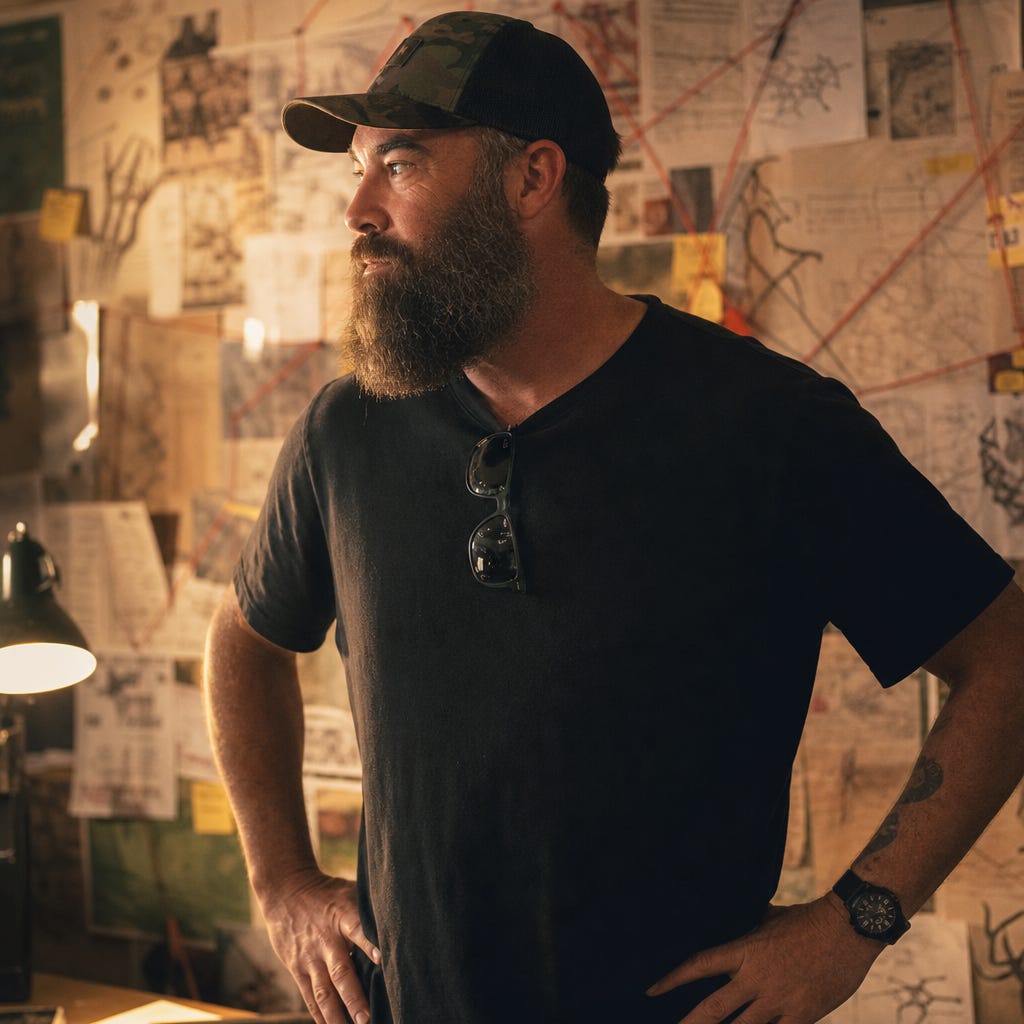
Once I saw this, I started noticing it everywhere in my life, at every scale. Given a task that requires output, I will build the machine that produces the output before I will produce the output directly. I have always plastered conference room walls with printouts of diagrams, charts, and designs. On one ETL transformation project, my coworkers called it a “murder investigation wall” when I got out the yarn to show the connections between everything. When my full-time job went remote during COVID, the first thing I bought for my home office was a six-foot whiteboard and a stack of Post-Its. I cannot work from a single 17-inch monitor on a work laptop. I need my conference rooms back.
I spent two and a half years building jonmick.ai, a 169-table personal system with a voice agent that briefs me each morning, rather than manage my life and reconstruct my priorities from memory. It is the largest surface I have ever built.
The blank status report defeats me because it asks for the one move my architecture cannot make: produce output directly, on bare ground, in the four minutes before a 1:1. The same is true of the timesheet I let slide for weeks, the $400 in receipts from a work trip aging in my wallet, the monthly OKR review I rewrite from scratch every time. Each one is the same structural request: produce alone against the clock. I lost thousands of dollars this way when a startup I worked for folded with my expense reports still in my wallet. Everywhere else, given a surface and the time to build one, I generate as well as anyone. These tasks simply never let me build the surface.
There is one more piece of this I am only recently letting myself say out loud. The surfaces I build at full intensity rarely land with the people I build them next to. Coworkers admired the murder-investigation wall and then stopped engaging with it. Whiteboards that fully captured a project emptied the room. People who heard me at full generative bloom would soften, change the subject, ask me to slow down. For most of my life I read this as a failure of my output. I have started reading it as the cost of generative mode at full intensity: high-fidelity, high-context, branching, all at once, and almost no one is built to receive it. A lifetime of producing into rooms that cannot hold what you produce leaves its own kind of trauma response. By the time Charlotte stood at my desk, I had been calibrating down for so long I no longer recognized I was doing it.
What Charlotte Did

I can name now what happened at that desk.
Charlotte did not write my status report. She could not have. She did not know what I had worked on that week. The knowledge was entirely mine, sitting in my body the way it always does, complete and detailed and impossible to reach.
What she did was hold a surface in front of me and build it while I talked. Every bullet she typed was a piece of context I no longer had to keep in my head. It was on the screen now, stable and visible, holding still. The screen filled, and as it filled, the holding I cannot do was being done for me, in real time, by someone sitting in a chair.
I was generating the entire time. Every word of that report came from me. But I was generating against a surface that grew as fast as I could speak, and that changed everything. I was talking, watching my own thinking appear on the screen, and reacting to what I saw. The hardest task of my week had quietly become responsive mode.
Charlotte stopped me.
I had more to say. I always have more to say, because nothing inside me signals that the thing is finished (the clinical name for this is perseveration). Generative mode has a kind of natural completion. Once the surface is built, the surface is built. The trouble is responsive mode, when I am adding to a surface that already stands. I have no signal for when there is enough on the screen. Left alone, I would have kept producing bullets for another hour, each one feeling as essential as the last, the report swelling past anything my boss wanted or needed. Charlotte looked at the surface, the actual bullets on the actual screen, and saw that it was enough. She could see that because she was holding it while I was inside it. “That’s good. Send it.”
If nothing inside me signals when the bullets are enough, I have started to wonder what signals when I am enough. It is the same architecture, asking a much larger question. I can feel the urge to keep developing it right now, which is exactly the perseveration showing up in the writing of this very essay. So I will do here what Charlotte did at my desk. That belongs in another essay.
I have written before that in live conversation, the other person becomes my working memory scaffolding. I meant it as a metaphor. That afternoon it was not a metaphor. Charlotte was working memory made of a person, sitting at my desk, typing while I talked and telling me when to stop.
It worked. And then it was over, because Charlotte has her own life and her own work, and I cannot summon her to my desk every Monday at 4pm. The surface ended when she left my office. The next week the page was blank again.
A Surface I Can Summon
What I needed was not Charlotte specifically. Charlotte would be the first to tell you that. The function she performed that afternoon was separable from her. I needed a surface built in real time, by something that could hold my overflow and structure it and tell me when it was full. I needed that available on a Monday at 4pm whether or not anyone was free to stand at my desk.
That function is what an AI chat actually is, underneath the noise about what these tools can and cannot do.
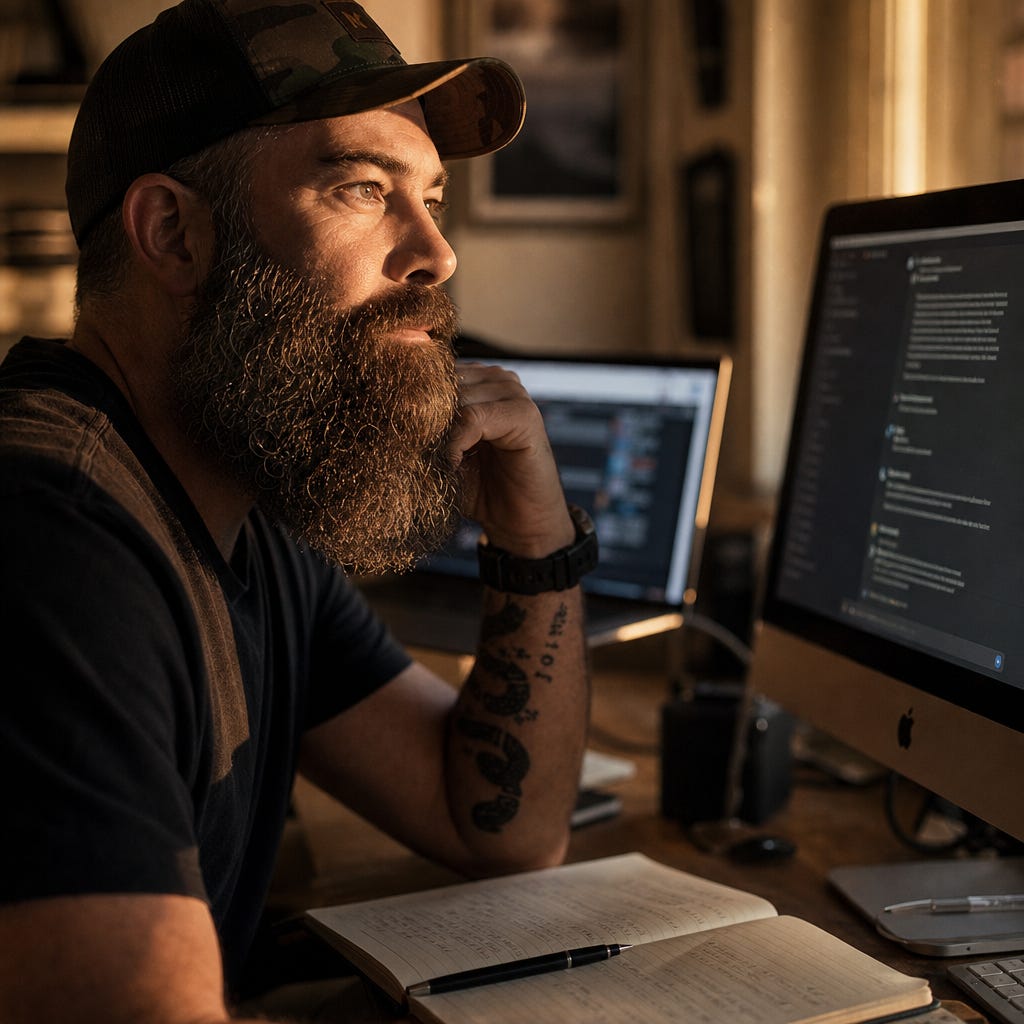
When I open a chat and start working through a problem, the thinking is still mine, the way the status report was mine. What the AI does is build the surface while I talk. I write the loose, branching, overflowing version of what is in my head, and it reflects back something structured. Every exchange adds to the surface. A few turns in, there is a stable record of my own thinking sitting in front of me, and the moment I can see it, I can work with it. Generative mode has quietly become responsive mode again. The conversation is the whiteboard.
It performs the other function too, the one Charlotte did when she told me to send it. I can ask an AI whether I have said enough. I can ask it what is essential and what is a caveat I should cut. It reads the surface, because the surface is right there in the conversation between us, and it gives me the signal my own architecture does not generate. The stop signal became something I can summon.
I will tell you something about this article, since we are here. I cannot write a status report alone. This piece is roughly twenty times longer than a status report and on a far subtler topic, and I am writing it without much trouble. I am writing it because I did not start from a blank page. I started by talking, the way I talked to Charlotte at the desk, and a surface got built as I went. Now I am doing the thing I am genuinely good at, which is responding to a structure I can see. As of this paragraph, the draft sits on paper next to my coffee machine, so I can read it and write feedback in the margins. What you are reading is evidence of what it describes.
The AI here is a surface, and nothing grander than that. The intelligence in this article is mine. The architecture that let me reach it is shared.
Nobody Thinks Alone

When a colleague writes their status report in twenty minutes, they are working against a surface too. Theirs just lives inside their head. Working memory holds the week for them, the shape of the report, the sense of when it is finished, and it does this so quietly and so reliably that they have never once had to notice it is happening.
I was held to a standard called “do this by yourself,” and I spent decades failing it and calling the failure a character flaw. But the standard was never real. Nobody does this by themselves. The blank page is a test of one specific thing: whether your working memory will hold a surface for you silently. Mine will not. What separates me from that colleague is location. Their surface lives in working memory. Mine has to live in the world.
For most of my life, the fact that mine lives in the world was something I could not explain. I felt the blocker without being able to name it. The shame was never about needing a surface. I am proud of my murder-investigation walls, even when I am the only one who fully understands them. The shame was about the procrastinating and the lacking, the deadlines slipping and the reports going unfiled, the looking unreliable for reasons I could not articulate. Now that I can name the architecture, the shame has had somewhere to go. A surface I can see is a surface I can examine, improve, and hand to someone else. The invisible kind cannot be shared. Mine can.
If you recognize yourself in the blank page, in the report you cannot start, in the conversation you have reopened eleven times without answering, I want to give you the thing this piece has been circling. You do not need more discipline. You have been trying to think alone, and alone was never the assignment. Build the surface. Talk to something that will hold it with you. And stop apologizing for the fact that yours is visible.
What I just did in this essay is the method itself: read your own architecture as architecture rather than as a deficit, name the mechanism under the surface, strip the shame off it, and translate the residue into language you can carry. That is the work, and it is portable.
This is why I am building what I am building. I am building surfaces. Places for a mind to become visible to itself, so the thinking it was always capable of finally has somewhere to land.
The status report my boss called perfect was me, the same me as every other week, finally able to be seen, because for one afternoon my thinking had a surface and someone to hold it.
That is all any of us are asking for.
Human. Deeply seen.
Jon Mick is the founder of AIs & Shine, an AI-powered platform that helps minds become visible to themselves, incorporated as a Delaware Public Benefit Corporation because the mission of helping people matters more than aggressive scaling. He writes about the intersection of technology, self-discovery, and different brains at AI Gave Me Autism.