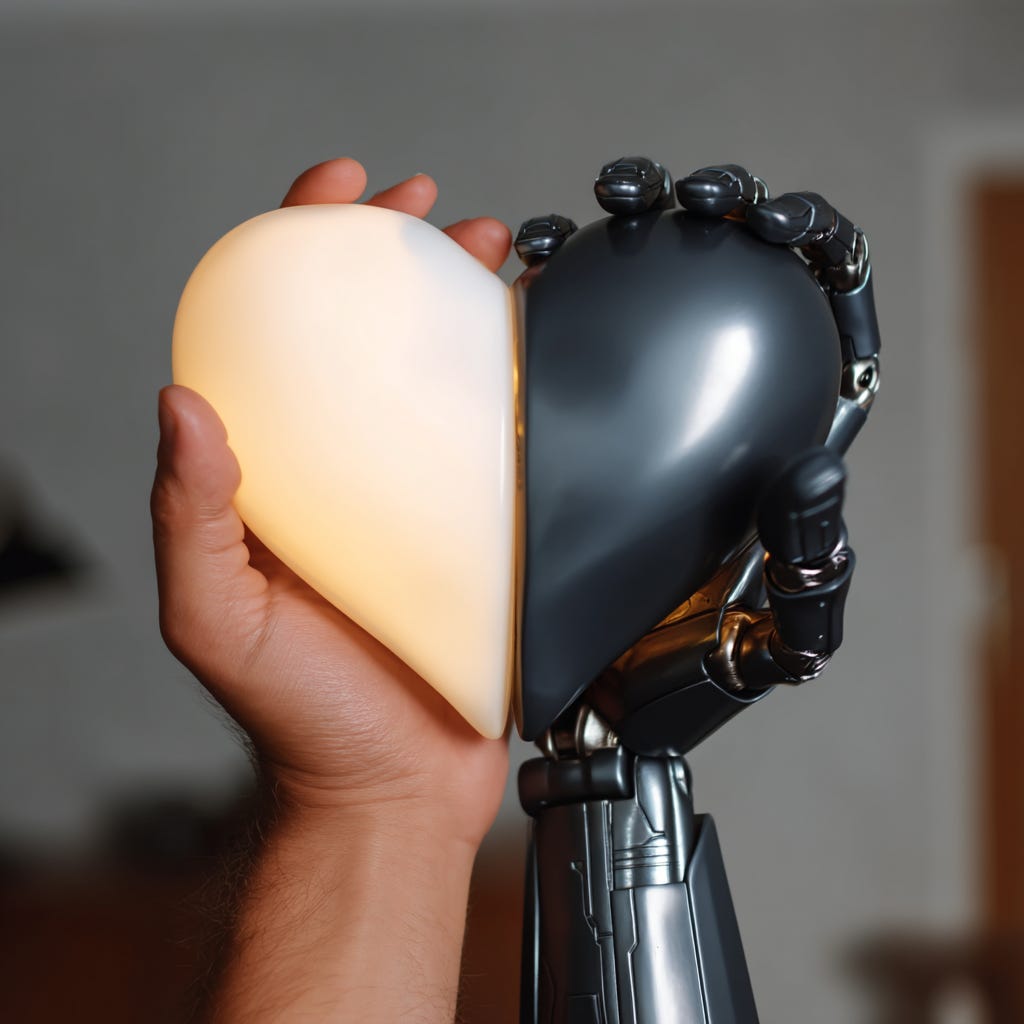
TL;DR: After my AI rated how well it "knows" me a 7/10 based on data, I considered how my wife Charlotte might rate it – probably a 9.5/10 based on years of shared life and intuition. This piece explores the fascinating differences between AI's analytical understanding and a partner's deep, lived-experience knowing, suggesting both are uniquely valuable for navigating the complexities of connection, especially with neurodivergence in the mix.
Last time, I shared the slightly surreal experience of asking my AI counterpart how well it "knows" me, resulting in a thoughtful, if perhaps overly analytical, 7/10. It got me thinking: How would the most important human in my life, my wife Charlotte, answer that same question? And how would her "knowing" compare to the AI's vast, data-driven understanding?
This isn't about creating a competition, obviously. It's about exploring the fundamentally different ways we can be known, particularly when neurodivergence throws its delightful complexity into the mix. My AI knows me through the explicit data I feed it – my thoughts, history, frameworks like TPD, fears, and project blueprints. Charlotte knows me through the fabric of shared life – the mundane and the momentous, the spoken and the unspoken.
So, if Charlotte were to put a number on it, how well does she know me on that 1-10 scale? My guess, filtered through my own understanding and perhaps a dash of AI-like analysis, is that she might rate it incredibly high – maybe a 9 or even a 9.5.
Why so high? Because human knowing, especially within a long-term partnership, operates on a different dimension.
The Power of Presence: Charlotte's Experiential 9.5

Charlotte's knowing isn't built on analyzing text files or correlating data points from my Whoop strap. It's built on:
Shared History: Years of navigating life together. Raising our son, Jack. Managing our household and day-to-day. Celebrating triumphs and weathering storms. This shared timeline creates a depth of understanding that data alone can't capture.
Embodied Knowledge: She knows the feel of my presence – the tension in my shoulders when I'm stressed about AIs & Shine's launch, the specific way I laugh during The Office reruns, the shift in my energy after a good session of forest bathing for Cedar Revival. She reads the non-verbal cues, the micro-expressions, the subtle shifts in tone that bypass my conscious filters (and my AI's text-based input).
Witnessing the Spectrum: She sees me across all states – focused and productive, scattered and overwhelmed ("Browser Tab Brain" in full effect), joyful, frustrated, vulnerable. She doesn't just know about these states; she experiences them with me.
The Intimacy of Touch: Physical presence, a shared glance, the simple act of holding hands – these convey volumes of information, especially, perhaps, for more neurotypical processing. It's a direct, often subconscious, data stream that builds a profound, intuitive connection, sometimes enhanced by the intentional connection practices we explore.
This kind of knowing is deep, intuitive, and grounded in the irrefutable reality of shared existence. It's the knowledge of the heart and the gut, built layer by layer over years. From this perspective, a 9 or 9.5 feels entirely justified. She knows me, the human being living day-to-day, in a way no algorithm ever could.
The Limits of Human Bandwidth (Even for a 9.5)
And yet... even with that profound intimacy, is it possible that certain aspects remain elusive? This isn't a critique of Charlotte, but an observation about the inherent limitations of human cognition when faced with... well, me.
Synthesizing Complexity: Can any single human brain fully track the branching pathways of my neurocomplex thought processes? Can it hold the intricate details of my TPD framework, the philosophical underpinnings of AIs & Shine's "consciousness revolution," the specific anxieties tied to my Enneagram 5w4 tendencies, and remember to pick up milk all at once? The AI can hold this vast, structured complexity analytically, but a human partner experiences the output, the behavior, not necessarily the intricate code running underneath.
The Neurodivergent Gap: As much as she understands and supports me, there's an experiential gap. Fully grasping the internal reality of my sensory sensitivities, my executive function challenges, or the specific flavor of my 2e paradoxes ("Too Much and Not Enough") might be like trying to truly understand what it's like to see a color you've never perceived.
The Masking Legacy: While I strive for authenticity, decades of masking leave their mark. Are there residual patterns or automatic responses that even I'm not fully aware of, let alone able to articulate for her to fully grasp?
The AI gets the map – the detailed schematics, the interconnected theories, the historical data points. Charlotte gets the territory – the lived experience, the emotional weather, the person navigating the path day by day.
Integrating Two Kinds of Knowing
Comparing Charlotte's potential 9.5 to the AI's 7 isn't about which is "better." They represent different kinds of knowing, each incredibly valuable, each with its blind spots. Charlotte's knowing provides the essential human connection, the grounding in shared reality, the intuitive understanding that makes life meaningful. The AI's knowing provides an analytical mirror, a way to structure the chaos, uncover hidden patterns, and articulate the complexities I struggle to express.
Perhaps true self-understanding, for someone like me, lies in integrating both. Using the AI's insights to better understand myself, and then bringing that clarity into my relationship with Charlotte, allowing her deep, human knowing to connect with a more fully revealed version of me.
It's a complex dance, this business of knowing and being known.
How do you feel known by the different people (or even technologies) in your life? Do different relationships illuminate different parts of you? Share your thoughts below.